
Andreas Glatz – Optical Foundations for IP Engineers: From Fiber Basics to CWDM/DWDM and Link Budgeting
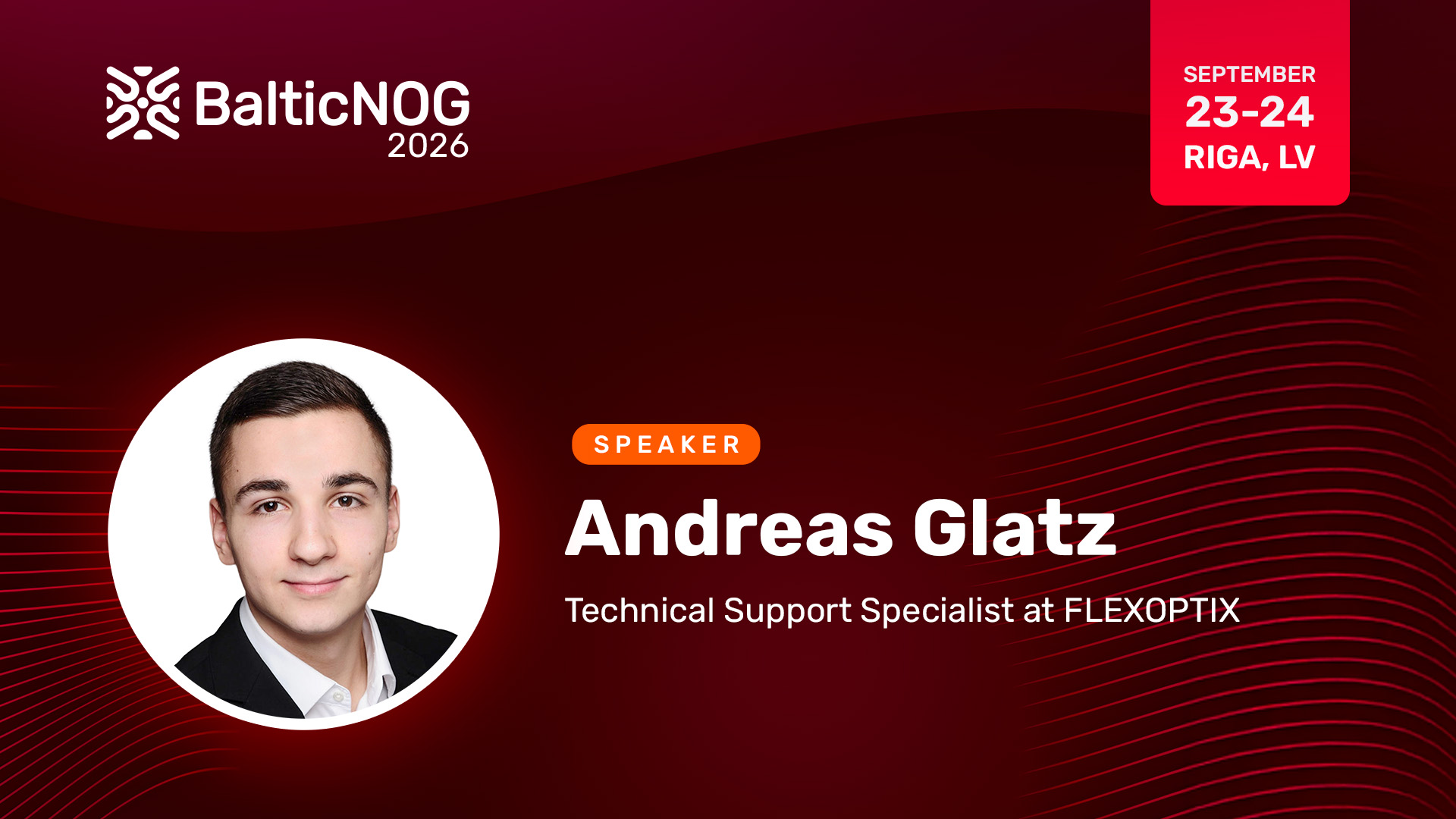
Andreas Glatz has worked in optical networking since 2022. He started in pre-sales engineering for DWDM transport systems, spending around two years working with customers on optical transport designs and solution scoping. He then moved into transceiver support and has spent about a year as a Technical Support Specialist at FLEXOPTIX in Darmstadt, where his work covers customer support for transceivers and fiber optics, compatibility testing of optical modules against different network devices, and technical documentation.
At BalticNOG 2026, Andreas will bring this hands-on support experience to the stage with his talk, “Optical Foundations for IP Engineers: From Fiber Basics to CWDM/DWDM and Link Budgeting.”
Beyond “Plug and Forget”
IP engineers often treat transceivers as a black box, something that just converts electrical signals to optical and back, with nothing more to think about. Andreas’s talk pushes past that assumption with a concise, practical introduction to the optical fundamentals every IP networking professional runs into sooner or later.
Fiber Types, Connectors, and Where Loss Comes From
Andreas will cover the structural and operational differences between single-mode and multi-mode fiber, along with the connector types you’ll actually encounter and how they get used. From there, he’ll dig into optical losses in practical terms: how attenuation builds up across fiber runs, connectors, and splices, and how to calculate link budgets so a design actually has enough margin to work in production, not just on paper.
Scaling Capacity with CWDM and DWDM
The talk also introduces wavelength-division multiplexing, covering both CWDM and DWDM. Andreas will explain their characteristics, channel spacing, and typical use cases, along with where each one fits into modern packet-optical networks.
Real Failures from the Support Desk
Every topic gets grounded in real failure cases Andreas has seen through transceiver support: single-mode optics plugged into multi-mode fiber, contaminated MPO connectors, mismatched UPC and APC polish types, and CWDM links that turn out to be limited by dispersion rather than attenuation. These are the kinds of problems that look like a hardware fault but actually come down to a physical layer detail someone missed.
Why You Shouldn’t Miss This Talk
If you’ve ever swapped a transceiver and hoped that would fix the problem, this talk gives you the physical layer knowledge to actually diagnose it instead. Andreas brings a support engineer’s view of what actually goes wrong in the field, not just textbook theory.
Whether you design optical links or just want to stop treating transceivers as a mystery box, this talk gives you a solid, practical foundation.
📅 When: 23-24 September 2026
📍 Where: BalticNOG 2026, Riga, Latvia
🔗 Don’t miss BalticNOG! Register today: https://balticnog.org/tickets/