
Dmytro Shypovalov – Auto-bandwidth for Segment Routing
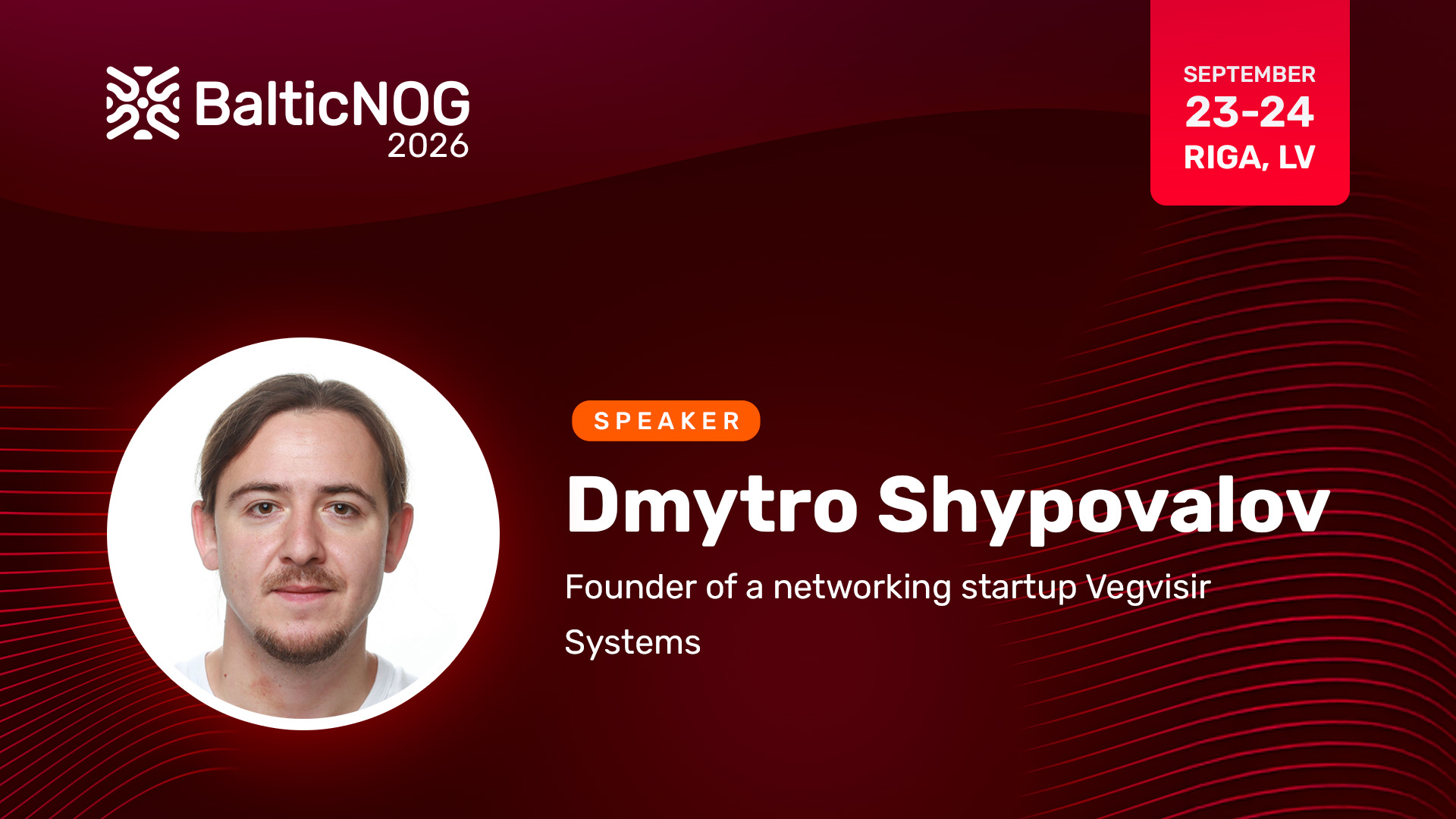
Dmytro Shypovalov is a network engineer and founder of Vegvisir Systems. He built Traffic Dictator, a multi-vendor SR-TE controller, and works on practical tools for network automation and traffic engineering.
Many ISPs use MPLS-TE auto-bandwidth to balance traffic across their networks. But the move to Segment Routing creates a real problem: SR is stateless, so the tricks that made auto-bandwidth work under RSVP-TE don’t carry over directly.
At BalticNOG 2026, Dmytro will bring his work on this problem to the stage with his talk, “Auto-bandwidth for Segment Routing.”
Why RSVP-TE Auto-bandwidth Runs Into Trouble
Under RSVP-TE, each router measures traffic on its LSP and adjusts bandwidth reservations on its own. Dmytro will walk through why that model creates operational headaches at scale: independent signaling per router means no deterministic routing, and every reoptimization can produce different results. Auto-bandwidth also struggles to react to changing BGP destinations, and adding new routers means reconfiguring LSPs across the whole network.
The Stateless Challenge of Segment Routing
Segment Routing fixes a lot of these interoperability and scaling problems. Traffic gets mapped to an LSP through a standardized color scheme instead of per-router signaling. The tradeoff is that SR LSPs are stateless: routers don’t know about transit LSPs the way they did under RSVP-TE. That means a controller, a PCE, has to handle bandwidth reservations, and building auto-bandwidth requires a feedback loop between that controller and the network.
Building the Feedback Loop, in Practice
Dmytro will demonstrate a working prototype built around this feedback loop. A PCE receives topology through BGP-LS, computes policies, and pushes them to the network using BGP-SRTE. A bandwidth sampler, open source and built by Dmytro’s team, collects SR LSP counters through GNMI and reports traffic rates back to the PCE. It currently works with IOS-XR, JUNOS, and EOS.
The talk includes live output from a mesh template deployment across multiple PEs, showing auto-bandwidth reservations adjusting in real time as traffic moves through the network.
Redundancy, Limitations, and Where This Goes Next
The design is built on open standards, so it fails in predictable ways. PCEs can run in multiples without proprietary state-sync, and if a sampler goes down, it just restarts elsewhere. Dmytro will also be direct about the current approach’s limits: advertising a traffic rate instead of raw counters means no historical data, no control over sampling method, and no visibility into link quality.
He’ll close with where this is headed: pulling raw counters into a proper telemetry layer using tools like Telegraf and VictoriaMetrics, so the PCE gets a full view of the traffic matrix and can support analytics, predictions, and rollback.
Why You Shouldn’t Miss This Talk
If your network is moving from MPLS-TE to Segment Routing, auto-bandwidth is one of the harder problems you’ll run into. Dmytro’s talk doesn’t stay theoretical: he shows a working prototype, real output, and an open-source tool you can look at yourself.
Whether you operate an SR network today or are planning the transition, this talk gives you a concrete path for solving a problem most vendors haven’t fully addressed yet.
📅 When: 23-24 September 2026
📍 Where: BalticNOG 2026, Riga, Latvia
🔗 Don’t miss BalticNOG! Register today: https://balticnog.org/tickets/