
Steve Crocker – Project Jake
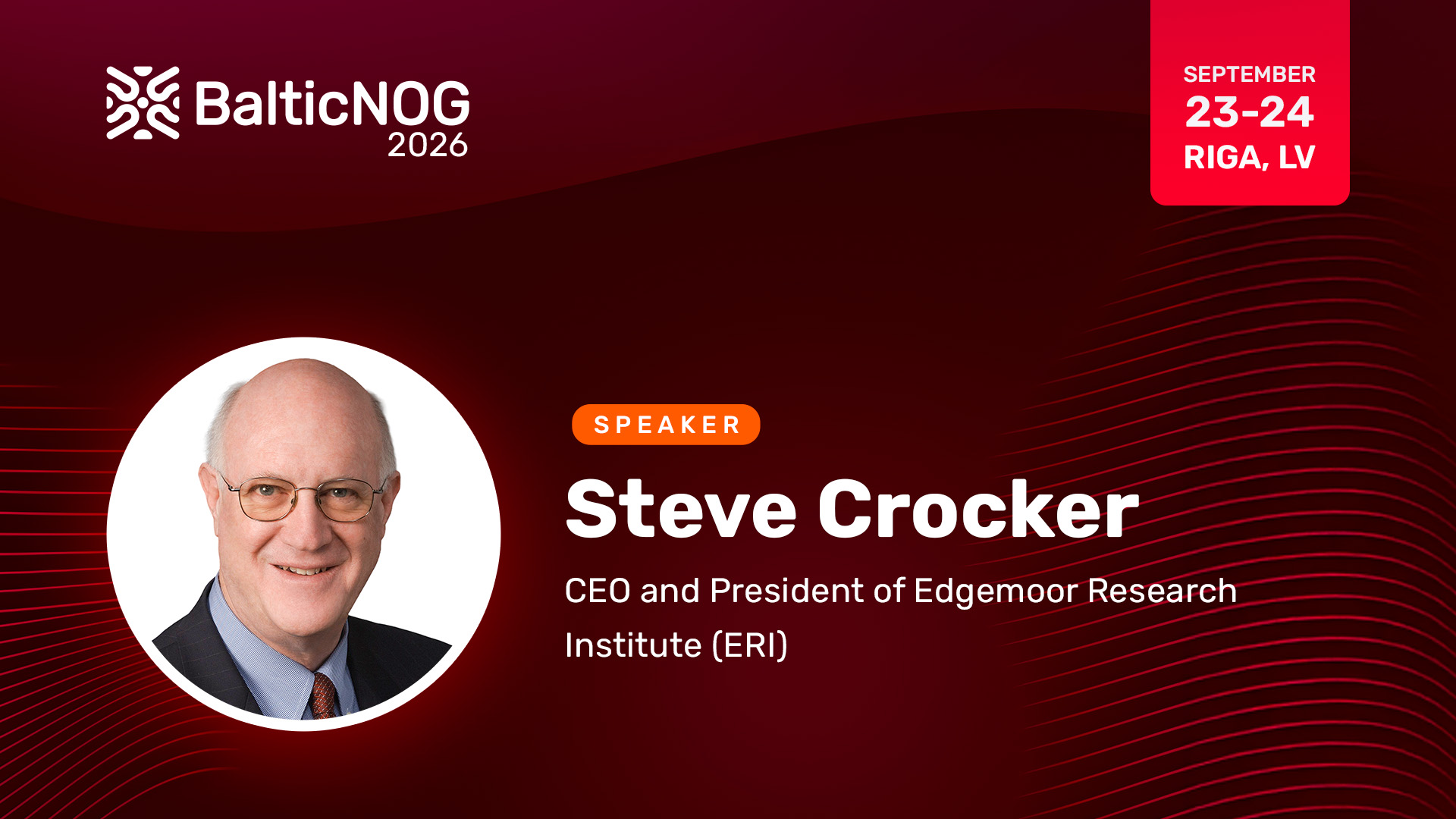
Steve Crocker is CEO and President of the Edgemoor Research Institute (ERI), which develops and analyses proposed and existing policies around the collection of and access to registration data, including personally identifiable information. ERI’s flagship effort, Project Jake, is a practical framework for internet domain name registration data disclosure.
Steve is widely regarded as one of the internet’s founding figures. As a graduate student at UCLA in the late 1960s and early 1970s, he was part of the team that developed the protocols for ARPANET, laying the foundation for today’s internet. He organized the Network Working Group, the forerunner of today’s IETF, and initiated the Request for Comments (RFC) series through which protocol designs are still documented and shared, authoring RFC 1 himself in 1969, the very first document in that series.
He managed research at DARPA in the early 1970s, founded the computer science research laboratory at The Aerospace Corporation in 1981, and co-founded CyberCash, Inc. Starting in 2002, he held leadership positions at ICANN, first as founding chair of the Security and Stability Advisory Committee, then on the ICANN Board from 2003 to 2017, chairing it for the last six and a half years and overseeing the 2016 transition to independence from the NTIA agreement. He is an ACM Fellow and a founding member of the Internet Hall of Fame Pioneers, among other honors.
At BalticNOG 2026, Steve will bring this decades-long view of internet governance to the stage with his talk, “Project Jake.”
Why Whois Needs Rethinking
Whois grew out of the early ARPANET, before there was an internet, a Domain Name System, or a World Wide Web. Registration data collection evolved incrementally, without much organized attention, and access was wide open until abuse forced a reaction. GDPR then pushed the pendulum hard toward maximum privacy, but without much clarity, efficiency, or effectiveness behind it.
Project Jake starts from that history and asks what a deliberately designed system would actually look like.
An Engineering Layer, Not a New Policy
Project Jake’s key principle is narrow on purpose: support the implementation of existing registration data disclosure policies, including the RDRS, rather than write new ones. Since 2020, the project has brought together registries, registrars, requestors, policy experts, and technical leaders to design workable, accountable frameworks for modern domain data governance, built on a clean division between policy and mechanism.
Requestors, Data Holders, and the Agreements Between Them
Steve will walk through Project Jake’s core architecture. Requestors and Data Holders each organize into groups, with an admin who can act on the group’s behalf, and an Agreement sits between a Requestor Group and a Data Holder Group defining purpose, permitted uses, access level, and expected data elements for each type of request. The design is fully distributed: requests go directly to Data Holders, with no central switch in the middle.
On the data side, every element collected at registration gets an explicit sensitivity level and validation level, with local policy governing how those assignments work, down to different treatment for different subsets of registrants.
From Design to a Live Pilot
Project Jake is now running a pilot with TWNIC, Taiwan’s TLD operator, built on standard protocols including RDAP, RFC 9560, and OpenID/OAuth, with Jake-specific extensions published and freely available. Steve will show what this looks like in practice, including how the same registration data renders completely differently depending on the requestor’s access level, from a minimal public view down to full disclosure for an authorized request.
Why You Shouldn’t Miss This Talk
If you’ve ever dealt with the friction and inconsistency around Whois and registration data access, this talk comes from someone who helped build the internet’s earliest protocols and has spent years since working directly on this exact problem. Steve brings both historical context and a concrete, already-piloted framework.
Whether you work at a registry, registrar, or on the requesting side of registration data, this talk gives you a clear look at where this framework stands today and where it’s headed next.
📅 When: 23-24 September 2026
📍 Where: BalticNOG 2026, Riga, Latvia
🔗 Don’t miss BalticNOG! Register today: https://balticnog.org/tickets/